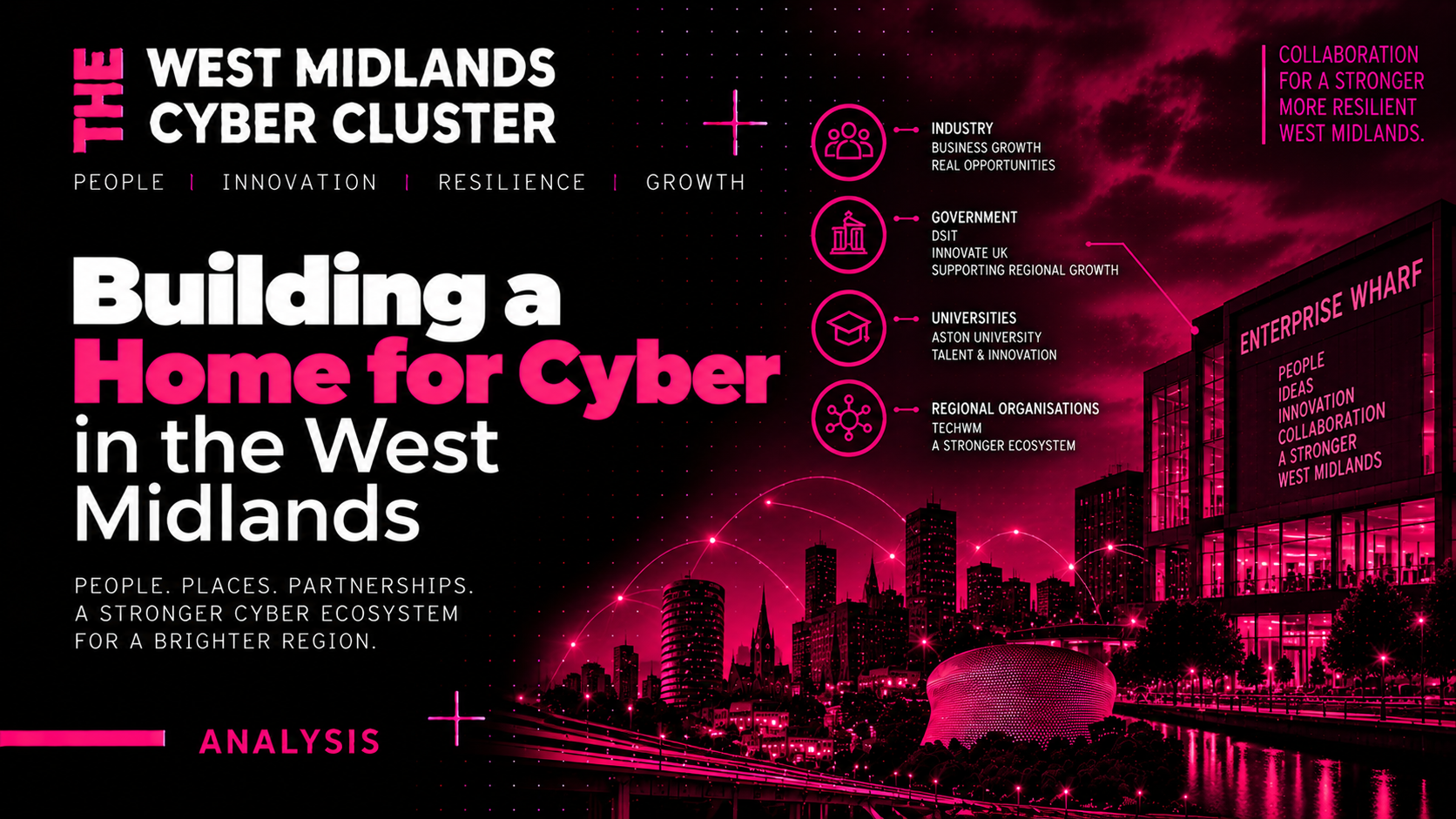
The West Midlands cyber ecosystem has developed through collaboration between industry, government, universities and regional organisations. We look back at the foundations of the Cyber Hub and the journey towards a stronger regional cyber cluster.
Contents
- Contents
- Building a Home for Cyber in the West Midlands
- Key Takeaways
- The West Midlands Already Had a Cyber Community
- Community Coherence Became the Immediate Challenge
- The Case for a Physical Hub Was About Repeated Interaction
- Government Support Allowed the Proposition to Be Tested
- Enterprise Wharf Provided the First Physical Home
- Birmingham Was the Centre, Not the Boundary
- The Early Model Focused on Three Practical Connections
- The Pre-Launch Showed the Breadth of the Community
- Other UK Cyber Hubs Provided Lessons, Not Templates
- Neutrality Was Essential to the Hub’s Role
- Practical Use Would Determine Whether the Model Worked
- The Hub Was Built to Learn as Well as to Convene
- Establishing a Home Was the Beginning, Not the Outcome
Building a Home for Cyber in the West Midlands
By the middle of 2025, the West Midlands did not lack cyber activity. Universities were teaching and researching cyber security, specialist businesses were operating across the region, major employers maintained substantial internal capability, professional communities were active, and public organisations were increasingly concerned with resilience. What the region lacked was a sufficiently visible centre around which those different parts of the community could meet.
The creation of the West Midlands Cyber Hub was an attempt to address that problem practically.
Rather than beginning with another regional strategy, the initiative started from a simpler proposition: if businesses, practitioners, universities, students and public organisations were going to collaborate more effectively, they needed better opportunities to encounter one another. A physical home could provide continuity between conferences and formal programmes, make the regional community easier to navigate and give cyber activity a more visible presence within the wider West Midlands technology economy.
Two contemporary accounts, West Midlands Cyber Hub Diaries: Day One (Or Perhaps Day Sixty) and Pre-Launch Reflections: The West Midlands Cyber Hub, document that formative period. Read institutionally rather than personally, they record how the idea developed through the West Midlands Cyber Working Group, how government and regional partners became involved, and what the Hub was intended to achieve as it approached its formal launch.
The significance of that history lies less in the creation of another cyber organisation than in the problem it was trying to solve. The Hub was designed as shared infrastructure for a community that already existed but did not always experience itself as a connected regional ecosystem.
Read the Hub perspective. The West Midlands Cyber Hub looks at why the region needed an accessible home for its cyber community and how that idea developed into a platform for businesses, skills, collaboration and practical support, in the companion article “Building a Home for Cyber in the West Midlands”.
Key Takeaways
- The West Midlands Cyber Hub emerged from a recognition that the region possessed significant cyber capability but lacked sufficient coherence, visibility and opportunities for sustained interaction.
- The revitalised West Midlands Cyber Working Group concentrated initially on four related priorities: community coherence, inward investment, a regional Cyber Festival and the establishment of a physical Cyber Hub.
- Government support through the Cyber Local programme, alongside Aston University and regional partners, provided the means to turn the concept into an operational initiative during 2025.
- Enterprise Wharf in Birmingham provided the Hub’s initial physical home, while the underlying ambition remained regional rather than Birmingham-only.
- The early operating model concentrated on practical connections between students and employers, emerging businesses and established organisations, and universities and industry.
- Experience from other UK cyber ecosystems informed the approach, but the West Midlands needed a model reflecting its own universities, businesses, industrial economy and geography.
The West Midlands Already Had a Cyber Community
The starting point for the Hub was an important distinction between capability and coherence.
The West Midlands already contained many of the components associated with a cyber ecosystem. Universities across Birmingham, Coventry, Warwickshire, Wolverhampton and the wider region contributed education, research and technical expertise. Cyber businesses and consultancies served customers locally and nationally. Major employers maintained security teams of their own, while public-sector organisations, policing, professional associations and specialist communities contributed further capability.
The difficulty was that these assets were distributed.
A practitioner working within a large organisation might have relatively little contact with a founder developing a cyber product elsewhere in the region. Students could complete relevant degrees without routinely encountering the breadth of local employers. Businesses looking for cyber expertise could find it difficult to understand which organisations or support mechanisms were appropriate. University research and commercial demand could coexist without connecting consistently.
This was not evidence that nothing was happening. It was evidence that activity alone does not create an ecosystem.
Regional capability becomes more useful when people can discover it, relationships persist beyond individual events and organisations have somewhere neutral in which collaboration can begin.
The Hub proposition developed from that diagnosis.
Community Coherence Became the Immediate Challenge
One of the influences on the renewed regional effort was an assessment associated with the CyberFirst programme that scored West Midlands community coherence at two out of five.
The precise score should not be treated as a comprehensive measurement of the regional cyber economy. Its importance was diagnostic. It provided a clear external indication that the relationships between existing parts of the community were weaker than they could be.
The revitalised West Midlands Cyber Working Group subsequently concentrated its attention on four priorities: improving community coherence, increasing inward cyber investment, developing a flagship regional Cyber Festival and establishing a physical Cyber Hub.
Although distinct, these objectives were closely related.
A region seeking investment needs to be able to explain where its capability resides and how businesses can access it. A major cyber event can raise visibility, but its effect is limited if the community disperses immediately afterwards. Businesses, universities and practitioners can collaborate, but collaboration becomes easier when there are repeated opportunities for interaction rather than continual reliance on introductions between individuals.
A physical Hub offered a possible mechanism for creating that continuity.
It was not intended to replace the organisations already operating across the West Midlands. Its purpose was to give them another way to connect.
The Case for a Physical Hub Was About Repeated Interaction
The decision to pursue a physical location reflected a particular view of how professional communities develop.
Digital networks are valuable, particularly across a geographically dispersed region, but some relationships form more readily through repeated physical interaction. Conversations before and after events, introductions between people using the same workspace and informal exchanges between organisations can produce connections that are difficult to programme formally.
For cyber security, this was especially relevant because the community crossed several institutional boundaries.
It included people working inside cyber suppliers and people responsible for cyber within organisations whose principal business lay elsewhere. It included researchers, students, founders, senior security leaders, public officials and practitioners. Their reasons for participating were different, but their activities frequently overlapped.
The Hub was intended to make those overlaps more visible.
A student might encounter an employer outside a formal recruitment exercise. A startup could speak with an established company about an operational problem rather than simply meeting other startups. A university researcher could encounter a business facing a question relevant to current research. Practitioners from different organisations could build professional relationships that continued beyond a single conference.
None of these outcomes could be guaranteed by providing a building.
The proposition was that a shared place could reduce the friction involved in making them possible.
Government Support Allowed the Proposition to Be Tested
The move from concept to delivery was enabled through the Government’s Cyber Local programme, supported by the Department for Science, Innovation and Technology through Innovate UK.
The regional initiative brought together Aston University and a wider group of organisations involved in technology, cyber resilience, innovation and economic development.
This funding performed a catalytic function.
Creating a regional facility before a community has demonstrated how it will use that facility carries obvious risk. There are premises to establish, programmes to organise, partnerships to coordinate and practical operating questions to resolve before there is evidence of sustained demand.
Public support allowed the West Midlands to test whether a more permanent form of cyber community infrastructure could work.
That is an important distinction in assessing the initiative. The initial objective was not to prove that a building itself constituted a cyber ecosystem. It was to establish an environment in which existing networks could interact more consistently and then learn from how businesses, practitioners and students actually used it.
The first phase was consequently as much an experiment in regional coordination as it was a property project.
Enterprise Wharf Provided the First Physical Home
Enterprise Wharf in Birmingham became the initial home of the West Midlands Cyber Hub.
The location had practical advantages. Birmingham provides the largest concentration of population and business activity within the region, significant transport connectivity and proximity to universities, technology organisations and professional communities.
There was also symbolic value in establishing a recognisable cyber presence within the region’s wider innovation environment.
Cyber security can become institutionally isolated when it is treated as a specialist concern discussed principally among security professionals. Locating the Hub within a broader technology and enterprise setting helped position cyber as part of the region’s wider digital economy rather than a separate technical discipline.
That positioning was important from the beginning.
The intended audience extended beyond cyber suppliers. Organisations adopting technology also needed access to security expertise. Students needed to see cyber as a career market. Universities needed connections with commercial and public-sector demand. Technology companies needed to consider security as part of product and service development.
Enterprise Wharf provided a starting point for bringing some of those groups together.
The building, however, was never intended to define the geographical limits of the initiative.
Birmingham Was the Centre, Not the Boundary
The early Hub model recognised a fundamental feature of the West Midlands: relevant cyber capability is distributed across several cities, universities and industrial centres.
Birmingham was an appropriate location for a principal physical facility, but a regional initiative could not reasonably expect every meaningful cyber activity to take place there.
The pre-launch thinking therefore included a hub-and-spoke approach capable of reaching Coventry, Wolverhampton, Worcester and other parts of the wider region.
This was important for more than geographical fairness.
Universities, businesses and specialist communities develop relationships within their own local environments. A regional Hub that attempted to displace those networks would weaken rather than strengthen the ecosystem. The more useful model was to provide a centre of gravity while working through existing institutions and communities elsewhere.
Some activities could take place at the Hub. Others could move around the region. Digital channels could connect participants regardless of location, while partner organisations could provide access to networks that a central facility would struggle to build independently.
The principle was therefore regional connectivity rather than centralisation.
That distinction would become important to the Hub’s credibility. To represent the West Midlands, it needed to operate as more than a Birmingham venue carrying a regional name.
The Early Model Focused on Three Practical Connections
As the Hub approached its pre-launch in September 2025, its purpose could be expressed through three particularly important relationships.
The first was between students and employers.
Universities were already producing people with relevant cyber and computing knowledge, but education and employment are not automatically connected. Students need exposure to practitioners, realistic understanding of roles, work experience and opportunities to build professional networks. Employers, in turn, benefit from earlier relationships with emerging talent.
The second was between emerging businesses and established organisations.
Cyber startups and SMEs need customers, partners and feedback from organisations confronting real security problems. Larger businesses need access to innovation but can find smaller providers difficult to discover or engage through conventional procurement routes. Bringing the two communities into the same environment could create conversations that formal innovation programmes sometimes struggle to produce.
The third was between universities and industry.
Academic institutions contribute research, specialist facilities, education and intellectual capability. Businesses contribute operational problems, commercial requirements and routes through which knowledge can be applied. The Hub could provide another interface through which those communities encountered one another.
These relationships gave the initiative a practical purpose beyond networking for its own sake.
The test was whether bringing people together would lead to useful activity that would otherwise have been less likely to occur.
The Pre-Launch Showed the Breadth of the Community
The pre-launch event on 30 September 2025 provided the first substantial public demonstration of the model.
More than 100 people attended, spanning cyber and technology businesses, universities, public organisations, startup founders, students and practitioners. Aston University, Birmingham City University, the University of Warwick and the University of Wolverhampton were among the academic institutions represented, alongside organisations involved in regional cyber resilience, technology and innovation.
The breadth of participation was more significant than the headline attendance figure.
A regional cyber ecosystem cannot be constructed solely from cyber companies. It also depends on customers, researchers, educators, practitioners working inside other industries, public organisations and the institutions responsible for skills and economic development.
The pre-launch demonstrated that representatives of those groups were willing to convene around a common regional initiative.
It did not yet demonstrate that the Hub would become sustainable or economically consequential.
That distinction was recognised at the time. A successful launch could create visibility, but the more important question concerned what happened afterwards. Would organisations continue using the facility? Would communities organise activity through it? Would students and employers return? Would businesses regard it as useful rather than simply supportive in principle?
The value of the Hub would ultimately depend on repeated use rather than launch-day enthusiasm.
Other UK Cyber Hubs Provided Lessons, Not Templates
The West Midlands initiative did not develop in isolation.
Existing cyber ecosystems elsewhere in the UK demonstrated that physical and institutional infrastructure could contribute to regional cyber development. Hub8 in Cheltenham and DiSH in Manchester were particularly relevant reference points during the Hub’s formation.
Their experience offered useful lessons about convening communities, providing space and creating stronger connections between national cyber capability and regional economies.
Neither provided a template that could simply be copied.
Cheltenham’s ecosystem benefits from the presence of GCHQ and the NCSC, giving the area a national-security anchor that cannot be reproduced elsewhere through regional policy. Manchester has developed within a different metropolitan economy and institutional environment.
The West Midlands needed to begin with its own assets.
Its universities, technology businesses, professional communities and public institutions form part of that picture, but so does the structure of its wider economy. Manufacturing, engineering, automotive, aerospace and complex supply chains create a regional environment very different from one organised principally around government security institutions or financial services.
The early Hub did not need to define a complete regional cyber specialism immediately. It did need to avoid building an identity based principally on imitation.
The purpose of learning from other regions was to understand mechanisms that worked and then determine which of them made sense in a West Midlands context.
Neutrality Was Essential to the Hub’s Role
A shared regional facility also needed to navigate competition.
Cyber suppliers compete for customers. Universities compete for students, research funding and partnerships. Business-support organisations can operate across overlapping remits. Public institutions have different responsibilities and geographical boundaries.
None of this is unusual. It is a normal characteristic of an economic ecosystem.
The challenge for the Hub was to provide sufficient neutrality that organisations could collaborate without believing they were simply supporting somebody else’s institutional agenda.
This was one reason the idea of a shared home mattered.
The Hub could provide space for different communities without requiring them to surrender their identities. Existing networks could use it without becoming subordinate to a single regional organisation. Businesses could participate while continuing to compete commercially. Universities could collaborate on common interests while maintaining their institutional independence.
Neutrality in this sense did not mean an absence of purpose.
The Hub had a clear objective: stronger regional cyber connectivity. What it sought to avoid was the assumption that connectivity required central ownership of every activity taking place within the ecosystem.
That principle was important in 2025 and remains one of the more useful lessons from the Hub’s formation.
Practical Use Would Determine Whether the Model Worked
The strongest early test of the Hub was always going to be practical use.
Regional initiatives can generate goodwill relatively easily when their objectives are broadly positive. Businesses will generally support stronger collaboration, universities will support better connections with employers, and public organisations will support improved resilience.
The more demanding question is whether people alter their behaviour because the infrastructure exists.
Do practitioners choose to meet there? Do businesses seek support through it? Do communities organise activity around it? Do employers engage with students? Do organisations return after their first visit?
These behaviours provide evidence that the Hub is reducing a real form of friction.
They also distinguish infrastructure from promotion.
A regional cyber brand can improve visibility, but a physical Hub has operating costs and therefore needs a functional purpose. Its justification depends on whether the relationships made easier through the space are sufficiently valuable to sustain continuing participation.
The formative period during 2025 was consequently important because it began generating evidence about what the community actually wanted from such a facility.
That evidence would become more useful than the assumptions with which the project started.
The Hub Was Built to Learn as Well as to Convene
The early development of the West Midlands Cyber Hub should therefore be understood as an iterative process rather than the implementation of a finished institutional design.
The Working Group had identified weaknesses in community coherence. A physical Hub was proposed as one response. Cyber Local support made it possible to establish that Hub. Enterprise Wharf provided a home, while the pre-launch demonstrated that a broad cross-section of the regional community was willing to engage.
The next task was to learn from actual use.
Some assumptions would inevitably prove more valuable than others. Certain communities would need different forms of support. Businesses would bring problems that had not been anticipated during programme design. Students, universities and practitioners would use the space in ways that could not be predicted fully from the outset.
That capacity to learn was important because the Hub’s purpose was not to preserve a particular institutional model. It was to improve regional connectivity.
If experience demonstrated that activity needed to take place elsewhere in the region, the model needed to accommodate that. If businesses required practical support rather than additional events, programming needed to respond. If existing communities were already performing particular functions effectively, the Hub needed to work with them rather than duplicate their activity.
The measure of success was therefore usefulness, not adherence to the original plan.
Establishing a Home Was the Beginning, Not the Outcome
By October 2025, the West Midlands had moved from discussing the need for stronger cyber community infrastructure to establishing a physical Hub and testing it with businesses, universities, practitioners, students and regional partners.
That was a meaningful step, but it should be understood in proportion.
A building cannot create a cyber ecosystem. Nor can a launch event, a government grant or a new regional identity. What those interventions can do is make it easier for an existing community to discover itself, form relationships and begin working across institutional boundaries.
That was the significance of the Hub’s first phase.
The West Midlands already possessed cyber capability. The challenge was to make that capability more visible and connected. The Working Group provided an initial mechanism for coordination; government and regional partners helped convert the concept into something tangible; Enterprise Wharf supplied a physical centre; and the pre-launch demonstrated that there was a broad community willing to participate.
The longer-term consequences were still unknown in October 2025, and they should not be written backwards into the story.
At that point, the achievement was more fundamental: the region had created a recognisable home for cyber and begun testing whether shared infrastructure could strengthen relationships between people and organisations that had previously operated across a more fragmented landscape.
Later developments would build on those foundations. But the importance of the Hub’s origin lies precisely in what it was at the time — a practical attempt to turn a dispersed collection of cyber activity into a more connected regional community.