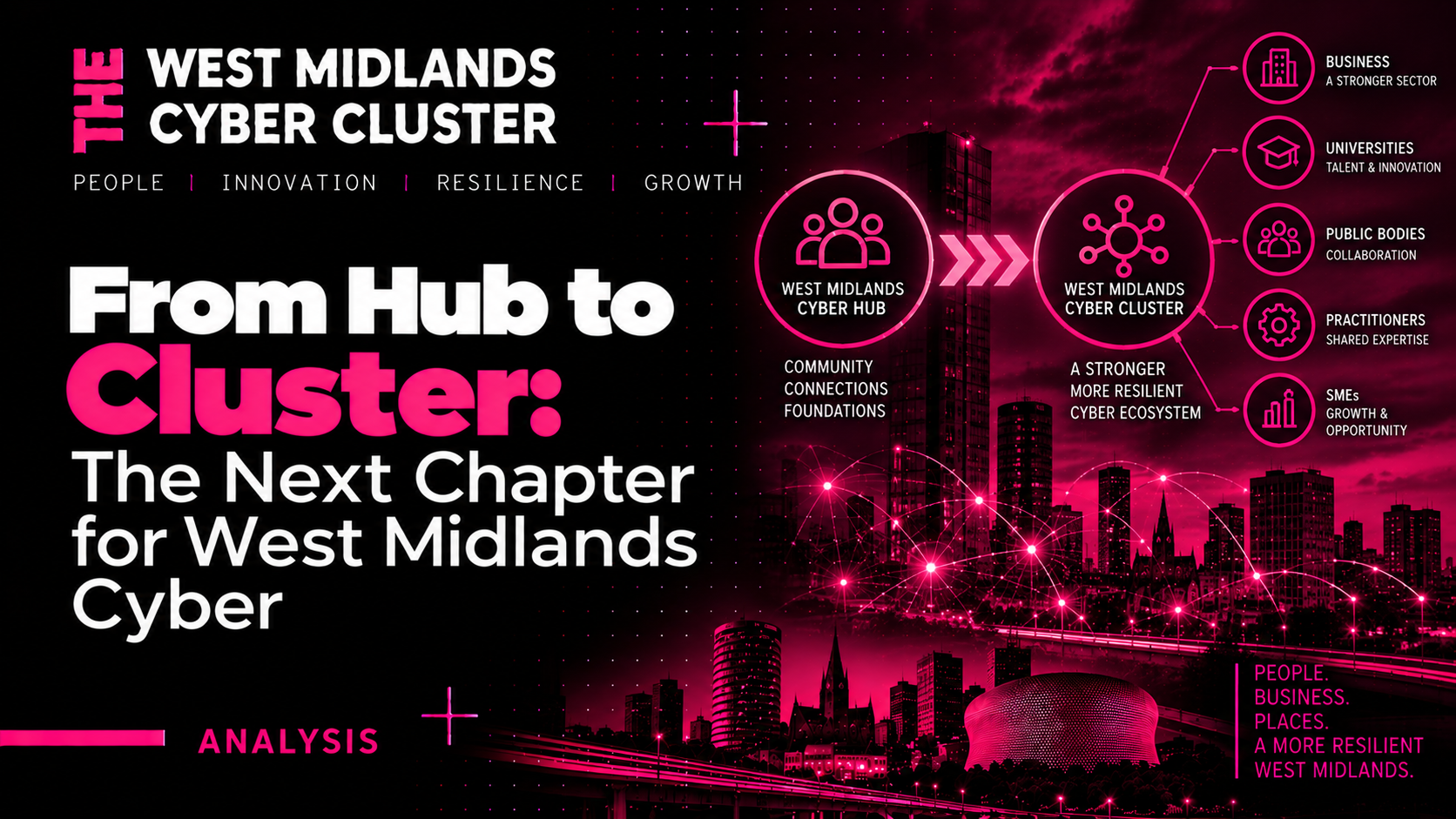
The West Midlands cyber community is entering its next phase. Building on the foundations established by the West Midlands Cyber Hub, the Cluster will strengthen connections among cyber companies, industry, universities, public bodies, and practitioners across the region.
Contents
- Contents
- From Cyber Hub to Cyber Cluster: Building the West Midlands Cyber Economy
- Key Takeaways
- The Starting Problem Was Fragmentation, Not Absence
- The Hub Tested Whether a Physical Centre Could Improve Coherence
- A Hub and a Cluster Solve Different Problems
- The Cluster Should Be a Network of Networks
- Cyber Is Horizontal, but It Is Also an Economy
- The West Midlands Already Has an Indigenous Cyber Business Base
- The Missing Regional Function Is Progression
- Customers Should Sit Near the Centre of the Cluster Model
- Industrial Cyber Resilience Provides a Distinctive Economic Proposition
- Investment Remains the Unfinished Part of the Regional Model
- Skills Policy Needs to Lead Somewhere
- Governance Matters Because Institutions Need to Outlast Individuals
- The Cluster Should Be Judged by Economic Outcomes
- From Community Infrastructure to Economic Infrastructure
From Cyber Hub to Cyber Cluster: Building the West Midlands Cyber Economy
Regional cyber ecosystems are often described through institutions: universities, businesses, government programmes, professional networks, accelerators and specialist organisations. The West Midlands has possessed many of these assets for years. What it has lacked more consistently is the connective infrastructure through which those assets can operate as a coherent economic system.
That distinction explains the evolution from the West Midlands Cyber Hub towards the West Midlands Cyber Cluster.
The Hub was created to address an immediate coordination problem. The region contained capable cyber businesses, practitioners, researchers, students, public-sector organisations and major employers, but activity was fragmented across institutional and professional networks. A physical centre could make that community more visible, provide somewhere for organisations to meet and collaborate, and create practical routes into cyber support.
The next stage requires a broader economic function.
The originating account, West Midlands Cyber Hub Diaries: I Went Quiet. The Work Didn’t, documents how the initiative developed from the earlier West Midlands Cyber Working Group, through the establishment of the Hub, towards an emerging Cluster intended to connect businesses, customers, investment, skills, research and professional communities. By August 2026, the Hub reported 39 events, more than 1,200 participants from over 500 organisations, support for more than 40 SMEs and more than 25 students progressing into placements or roles.
Those figures demonstrate reach, but they are not the principal economic argument for a Cluster. The stronger case is that the West Midlands already contains a substantial indigenous cyber economy alongside one of Britain’s largest concentrations of advanced manufacturing and complex industrial supply chains. The opportunity is to connect those capabilities well enough that the region produces more customers, stronger companies, greater investment, better career progression, and improved industrial resilience.
The Hub provides access to that ecosystem. The Cluster’s role is to strengthen the economic relationships within it.
Read the Hub story. The West Midlands Cyber Hub traces the development of the regional community from working groups and consultation through to the establishment of a permanent Hub, in the companion article “From Working Group to West Midlands Cyber Hub: Building the Regional Community”.
Key Takeaways
- The West Midlands cyber challenge is increasingly one of coordination and progression rather than simply creating additional programmes or organisations.
- The Cyber Hub has demonstrated demand for a physical and practical centre, reporting 39 events, more than 1,200 participants from over 500 organisations, support for more than 40 SMEs and more than 25 student placements or roles by August 2026.
- The emerging Cluster should operate as a network of networks, connecting existing cyber communities rather than attempting to centralise or replace them.
- Economic success requires stronger progression between education, employment, entrepreneurship, customers, SME growth and investment; these should be understood as parts of the same system.
- The West Midlands has an opportunity to differentiate around industrial cyber resilience and supply-chain security, using the region’s manufacturing and engineering economy as a source of real customer demand.
- The Hub and Cluster perform complementary functions: the Hub gives organisations practical access to the ecosystem, while the Cluster develops the relationships and economic infrastructure through which the ecosystem can grow.
The Starting Problem Was Fragmentation, Not Absence
The West Midlands did not begin its recent cyber development from an empty landscape.
Universities were already conducting cyber research and educating students. Cyber security businesses were operating across the region. Large employers maintained substantial internal security capabilities. Public-sector organisations, professional communities and specialist practitioners were active, while the regional industrial economy created significant demand for resilience.
The problem was that these capabilities did not always behave as parts of the same system.
The earlier West Midlands Cyber Working Group emerged from that context. Its development identified several practical ambitions: cyber needed greater visibility within the wider regional technology agenda; the community needed a physical space around which it could coalesce; the region needed stronger cyber events and professional connections; and more investment needed to flow into regional cyber businesses and capability.
These were coordination problems rather than arguments for creating cyber capability from nothing.
That distinction remains important because regional economic policy can easily become preoccupied with identifying missing institutions. If a problem exists, the instinctive response is often to create another programme, accelerator, network, committee or funding mechanism.
Sometimes that is necessary. Frequently, however, the constraint lies between existing assets.
A university can possess excellent research while companies struggle to access it. A cyber supplier can possess strong technology while lacking routes into major customers. Employers can report skills shortages while students struggle to obtain practical experience. Investors can say they lack regional deal flow while founders say they cannot reach investors.
Each component can therefore exist while the connection between them remains weak.
Cluster development should concentrate on those connections.
The Hub Tested Whether a Physical Centre Could Improve Coherence
The West Midlands Cyber Hub represented the first substantial attempt to turn that coordination objective into physical infrastructure.
The Hub opened at Millennium Point in Birmingham in November 2025 following support through the government’s Cyber Local programme and collaboration across regional organisations. Its purpose extended beyond providing workspace. The proposition was that a visible, accessible location could reduce some of the institutional distance between businesses, practitioners, students, researchers and support organisations.
The first months provide evidence that such demand existed.
By August 2026, the Hub reported 39 events involving more than 1,200 participants from over 500 organisations. More than 40 SMEs had received support through clinics, while more than 25 students had progressed into placements or roles. The physical environment had also developed to include hot desks, offices and resident organisations.
These outputs matter, but their significance lies in what they reveal.
A regional cyber community that repeatedly uses shared infrastructure is demonstrating more than an appetite for events. It is creating opportunities for relationships to form across organisations that might otherwise encounter one another only intermittently.
Companies meet potential collaborators. Students encounter employers. Practitioners exchange operational experience. Support organisations become easier to navigate. Businesses seeking cyber help can enter an environment containing several forms of expertise rather than needing to understand the institutional landscape beforehand.
Physical proximity does not guarantee productive collaboration, but it can reduce the transaction cost of discovering capability.
The Hub therefore addressed one layer of the original fragmentation problem.
It could not address all of it.
A Hub and a Cluster Solve Different Problems
The distinction between a Hub and a Cluster is more than terminology.
A Hub is principally a point of access and concentration. It can provide space, events, practical support, community activity and routes into relevant organisations. Its effectiveness is experienced directly by the businesses and people using it.
An economic cluster describes something broader.
Clusters develop where specialised businesses, customers, skills, research institutions, investors and supporting organisations interact repeatedly enough to generate advantages that would be harder to reproduce independently.
The Cluster’s task is consequently not to expand the Hub until it contains every regional cyber activity. It is to strengthen the relationships through which the wider economy functions.
That means connecting cyber suppliers with customers, investors with companies, employers with talent, researchers with operational problems and specialist communities with one another.
The distinction also helps prevent institutional overreach.
The Hub does not need to become an investment fund because cyber companies need investment. The Cluster does not need to become a university because the ecosystem needs research. Neither needs to replace existing professional associations, business-support organisations or cyber communities.
Their value lies partly in making those existing capabilities easier to find and combine.
This produces a useful division of labour: the Cluster develops the ecosystem; the Hub helps organisations access it.
The Cluster Should Be a Network of Networks
Regional coherence should not be confused with centralisation.
The West Midlands now contains professional associations, specialist cyber communities, university networks, student groups, leadership communities and sector-focused organisations. Their growth is evidence of increasing ecosystem depth rather than unnecessary fragmentation.
Different communities perform different functions.
A CISO network creates an environment for senior security leaders to discuss problems that may be inappropriate for a public event. Student communities provide peer relationships and entry points into the profession. Women-in-cyber networks can address representation and progression. Technical groups provide specialist learning. Universities create research and education networks. Sector groups connect practitioners facing similar operational environments.
Attempting to absorb all of these into a single regional organisation would destroy some of the specialisation that makes them valuable.
The more useful Cluster model is therefore a network of networks. The originating Hub account explicitly advances this principle: the role should be to connect successful communities, reduce unnecessary duplication, identify gaps and create pathways between specialist networks and wider industry, education, investment and government.
This approach changes the meaning of coordination.
Coordination no longer means everybody attending the same meeting. It means ensuring that useful relationships can form across network boundaries.
A student community should be able to reach employers. A cyber startup should be able to encounter senior buyers. An industrial organisation should be able to identify OT expertise. An investor should be able to find credible companies. A university researcher should be able to encounter genuine commercial and operational problems.
The Cluster creates value when those journeys become easier.
Cyber Is Horizontal, but It Is Also an Economy
One objection to regional cyber clustering is that cyber security is a horizontal capability rather than a discrete industrial sector.
The first part of that argument is correct.
Cyber risk exists across manufacturing, financial services, health, government, professional services, retail, logistics and almost every other part of the economy. Organisations need cyber capability because they depend upon technology, not because they belong to a single cyber vertical.
The conclusion that cyber therefore lacks a meaningful economic identity does not follow.
The UK’s 2026 Cyber Security Sectoral Analysis identifies 2,603 firms generating approximately £14.7 billion in cyber revenue and £9.1 billion in gross value added. The sector supports approximately 69,600 full-time-equivalent roles, while a wider population of security professionals works inside organisations whose principal business is not cyber.
Cyber therefore has two economic characteristics simultaneously.
It is a horizontal enabling capability supporting almost every sector, and it is a specialised market containing businesses, products, services, professions, research, investment requirements and labour-market dynamics of its own.
For the West Midlands, those characteristics reinforce one another.
Regional cyber companies can sell specialist capability into the industrial economy. Industrial customers provide demand against which cyber companies can develop expertise. Security professionals working inside major organisations can articulate operational problems. Universities can research those problems. Students can enter careers on both the supplier and customer sides of the market.
Treating cyber exclusively as a horizontal risks overlooking those reinforcing economic relationships.
The West Midlands Already Has an Indigenous Cyber Business Base
One of the more significant findings to emerge from the Hub’s development concerns the businesses already operating within and around its community.
Individually, many are SMEs and consequently appear small when compared with major national technology companies. Collectively, the Hub’s originating account argues, they represent a meaningful concentration of existing cyber revenue, customers, employment, intellectual property and commercial capability.
This matters because regional cyber narratives can become excessively focused on future potential.
A region may describe what it wants to become while overlooking companies that are already trading successfully.
The distinction affects policy.
An early startup needs help testing a proposition and finding its first customer. An established SME with revenue and employees may need access to larger customers, specialist leadership, international markets or growth capital. A scale-up requires something different again.
If the regional cyber economy is assumed to consist primarily of early-stage companies, support will naturally concentrate around startup formation.
If a meaningful population of established SMEs already exists, progression becomes at least as important as formation.
This is consistent with the national sector evidence. The UK has become increasingly effective at producing commercially substantial cyber companies, with 241 firms now generating more than £10 million annually from cyber activity, compared with 105 two years earlier.
The West Midlands needs its own progression route towards that level of scale.
The Missing Regional Function Is Progression
Education, entrepreneurship, SME support and investment are frequently administered as separate policy domains. For the businesses and individuals moving through them, they are stages of the same economic journey.
A student becomes a practitioner. A practitioner develops an idea and becomes a founder. A founder needs a first customer. A young company needs repeatable revenue. A growing SME needs experienced staff and access to larger markets. A scaling company may require external capital. Successful founders and employees can eventually become investors, mentors or customers for another generation of businesses.
Weakness at any transition reduces the value created by the stages before it.
Training someone without a route into work limits the return from skills investment. Supporting company formation without access to customers creates startups that struggle to commercialise. Introducing companies to investors before they possess commercial evidence rarely solves the underlying problem. Generating successful businesses without mechanisms for recycling their experience leaves knowledge isolated inside individual firms.
The emerging Cluster’s five-year model reflects this progression problem through connected activity around investment, senior cyber leadership, education and jobs, entrepreneurship, and lifecycle support for SMEs.
The importance lies in treating these as one system rather than five independent programmes.
Senior security leaders can expose genuine customer demand. Entrepreneurs can develop businesses around that demand. SMEs can obtain routes into larger buyers. Skills programmes can respond to the capabilities those companies and customers require. Investors can encounter businesses that have already developed meaningful commercial evidence.
When those relationships work, ecosystem development begins to compound.
Customers Should Sit Near the Centre of the Cluster Model
Regional innovation strategies frequently emphasise founders, finance and skills while giving less attention to customers.
For cyber companies, that is a significant omission.
Customers determine whether technology addresses a sufficiently important problem to justify expenditure. They provide revenue, operational feedback and reference deployments. A demanding customer can expose weaknesses that remain invisible during product development and can provide evidence that strengthens subsequent sales and investment.
The West Midlands has an important structural advantage in this respect.
Its advanced manufacturing, engineering, automotive, aerospace, defence-related and wider industrial economy creates persistent cyber demand. Connected production, operational technology, remote access, digital supply chains and software-intensive products all create security requirements.
The Cluster should therefore connect the development of the cyber sector with the requirements of the wider regional economy.
This does not mean encouraging organisations to purchase local products irrespective of quality. Such protectionism would reduce competitive discipline and ultimately weaken the companies being supported.
The objective is market access.
Regional cyber businesses should have opportunities to understand genuine industrial problems and compete to solve them. Large organisations should have better visibility of specialist regional capability. Procurement and assurance mechanisms should remain rigorous while avoiding unnecessary barriers that prevent credible smaller suppliers from competing.
A company that wins business because its capability is genuinely strong acquires something far more useful than ecosystem endorsement: a customer.
Industrial Cyber Resilience Provides a Distinctive Economic Proposition
The West Midlands should resist the temptation to define its cyber ambition principally through comparison with established ecosystems elsewhere.
Different places possess different structural advantages.
Cheltenham’s cyber identity has developed around national-security heritage. London benefits from financial services, major corporate headquarters, international capital and a large technology economy. Greater Manchester has invested significantly in digital-security infrastructure.
The West Midlands has a different proposition.
It combines an emerging cyber business community with one of Britain’s most important concentrations of advanced manufacturing and complex industrial supply chains.
That creates the foundations for specialisation around industrial cyber resilience.
The opportunity includes operational technology security, connected-product security, supply-chain assurance, industrial incident preparedness and the protection of digitally dependent production.
These are not arbitrary specialisms selected for regional branding. They emerge from the structure of the customer economy.
That matters because sustainable clusters tend to develop where specialist supply meets persistent demand.
A cyber company solving security problems for West Midlands manufacturers can subsequently sell that expertise elsewhere. A manufacturer gains resilience while the provider gains revenue and technical experience. Universities encounter research questions grounded in operational reality. Skills providers receive clearer information about specialist demand.
The relationship strengthens both the cyber sector and the industrial economy it serves.
Investment Remains the Unfinished Part of the Regional Model
The development of physical and community infrastructure demonstrates what can be achieved with relatively modest initial resources. The Hub was established from approximately £100,000 of Cyber Local funding, according to its August 2026 account.
That figure becomes instructive when placed alongside the scale of investment made in cyber infrastructure elsewhere.
The purpose of the comparison should not be to argue that every region requires identical public expenditure. Cyber ecosystems differ, and investment should respond to credible economic opportunities rather than regional competition over headline funding announcements.
The more important issue is whether the West Midlands possesses adequate capital pathways for the companies it is trying to develop.
Nationally, investment into dedicated cyber firms declined to £184 million across 47 deals during 2025, from £206 million across 59 deals in 2024. The financing environment has become more selective even while sector revenue and GVA have continued to grow.
Regional companies therefore need more than occasional introductions to investors.
They need relationships with angels, venture investors, corporate capital and other sources of growth finance appropriate to different business models. Investors need visibility of credible regional deal flow. Founders need enough understanding of capital markets to know whether equity investment is appropriate at all.
The Cluster can help coordinate those relationships without becoming an investment fund itself.
The objective is a functioning investment community around the cyber economy rather than another isolated source of funding.
Skills Policy Needs to Lead Somewhere
The same progression principle applies to education.
The West Midlands contains several universities producing students with relevant cyber and computing skills. Schools and colleges are increasingly involved in cyber education, while national programmes have raised awareness of cyber careers.
Entry into employment remains a separate challenge.
Employers frequently want experience, while people entering the profession need an opportunity through which to acquire it. Training provision that ends without practical exposure can therefore increase the number of qualified candidates without resolving the labour-market bottleneck.
The Hub’s early activity provides one indication of how regional infrastructure can intervene, with more than 25 students reported as progressing into placements or roles by August 2026. Its developing student community also brings together participants from Aston, Birmingham City, Coventry and Wolverhampton universities around mentoring, employer engagement and practical experience.
The longer-term opportunity is to connect the entire progression route.
School and college activity can build awareness. Universities and training providers develop knowledge. Practical projects and placements create experience. Employers provide careers. Experienced practitioners can move into entrepreneurship. Successful founders and senior professionals can subsequently support the next generation.
Education then becomes part of the regional economic system rather than an adjacent skills programme.
Governance Matters Because Institutions Need to Outlast Individuals
The transition from Hub to Cluster also raises a less visible but important question: how regional institutions become durable.
Many ecosystem initiatives begin through the energy of a small number of individuals. That entrepreneurial drive can be essential during formation because somebody has to convene partners, overcome delivery problems and keep activity moving when formal structures are still weak.
It is not a sustainable governance model indefinitely.
By August 2026, the Hub and Cluster were moving towards not-for-profit structures and a broader leadership model, while the Hub had secured a five-year home at Millennium Point. Subsequent plans also involved a transition away from dependence on founder-led day-to-day operation.
That transition is economically significant.
A regional institution needs sufficient independence that businesses, universities, investors and public organisations can regard it as shared infrastructure rather than the extension of an individual company or personality.
Governance should therefore provide continuity, accountability and representation while preserving enough operational flexibility to remain practitioner-led.
The objective is institutionalisation without bureaucratisation.
Too little structure leaves an ecosystem dependent on individuals. Too much structure can recreate precisely the institutional distance that practitioner-led initiatives were intended to overcome.
Finding the balance will be one of the Cluster’s more important tests.
The Cluster Should Be Judged by Economic Outcomes
The easiest measures of ecosystem activity are rarely the most important ones.
Events can be counted. Attendance can be counted. Organisations engaged, programmes launched and meetings held can all be reported relatively quickly.
These measures demonstrate activity and reach. They do not establish whether the regional cyber economy is becoming stronger.
A mature Cluster should increasingly be assessed through economic and capability outcomes.
Are regional cyber companies winning more customers? Are SMEs progressing into larger businesses? Is private investment reaching credible companies? Are industrial organisations gaining better access to specialist cyber capability? Are students moving into employment? Are practitioners creating new businesses? Are university research and intellectual property finding routes into operational or commercial use? Are larger organisations procuring successfully from regional suppliers?
There should also be resilience outcomes.
Are manufacturers improving their ability to manage cyber incidents? Are supply chains adopting proportionate assurance? Are businesses identifying critical dependencies more effectively? Is specialist OT capability becoming easier to access?
These measures are harder to collect and attribution will never be perfect. A Cluster cannot legitimately claim responsibility for every job created or contract won by an organisation with which it has interacted.
That is not the point.
The purpose of measurement is to determine whether movement through the regional system is becoming easier.
If companies repeatedly stall at the same stage, the Cluster should be able to identify the constraint and concentrate attention there.
From Community Infrastructure to Economic Infrastructure
The development of the West Midlands Cyber Hub demonstrated that there was demand for stronger community infrastructure.
The emergence of the West Midlands Cyber Cluster poses the harder question of whether that community can be converted into a more productive economic system.
The region does not need another institution that measures success primarily through its own activity. It needs coordination capable of increasing the effectiveness of organisations that already exist.
That means connecting networks without absorbing them, connecting students with careers, connecting founders with customers, connecting SMEs with larger markets, connecting industrial organisations with specialist capability, connecting research with demand and connecting credible companies with appropriate capital.
The Hub remains important within that model because economic ecosystems need points of entry. Businesses should not need to understand the full architecture of regional cyber support before they can obtain help. Students should have somewhere to encounter employers and practitioners. Companies should have somewhere to meet collaborators. Communities benefit from a physical centre of gravity.
The Cluster performs the complementary task of making the wider system work.
The opportunity is considerable because the West Midlands is not starting from zero. It already contains cyber businesses, experienced practitioners, research institutions, students, major technology users and substantial industrial demand. The discovery that much of its indigenous cyber economy has been hiding in plain sight should change the emphasis from creating an ecosystem to developing the one that already exists.
The next phase should therefore be judged by progression.
If more regional cyber businesses win substantial customers, if more of them grow into established SMEs and scale-ups, if investment begins to follow that commercial capability, if industrial organisations become more resilient and if people can move more easily from education through employment into entrepreneurship and leadership, the Cluster will be producing economic value.
That is a considerably more demanding objective than running a successful programme of events.
It is also what turns a cyber community into a cyber economy.